Showing posts with label Florida Herb Society. Show all posts

Wednesday, March 16, 2011

Florida Herb Society: Oh How I've Missed You!

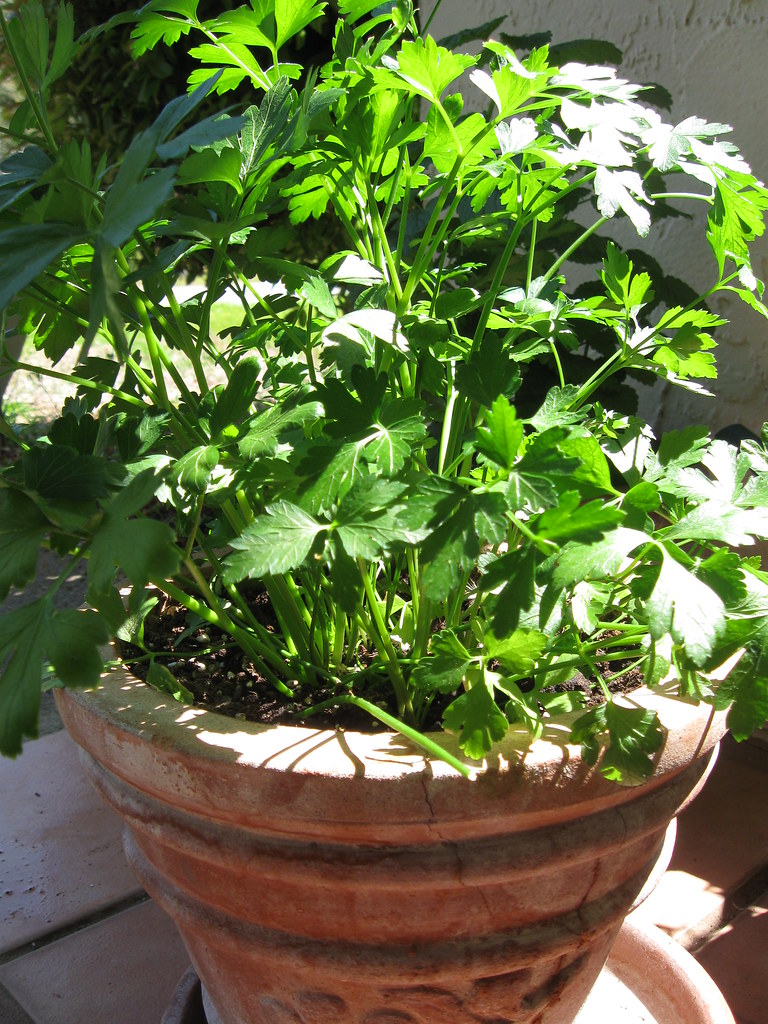
I finally go to go to an Herb Society meeting this month!  I haven't been since October because I keep getting scheduled to work on the night of the meeting.  I've missed seeing everyone & just being at the meeting so much!  The herb of the month is parsley, so there was all kinds of yummy foods at the tasting table & the guest speaker featured it in her healthy cooking with herbs demonstration.

Did you know that parsley is associated with death?  Apparently, the ancient Greeks placed it on corpses to control the smell.  If someone said that a person was in need of parsley, it meant that they were close to death.  Hemlock is very similar looking to Italian or flat leaf parsley and toxic, so the people of the Middles Ages preferred to use curly leaf instead so that they knew what they were eating.  The Romans would use parsley in baths for purification.  The English believed that parsley grows only for the wicked, not the just.  I find herbal folklore fascinating!

If you soak your head in a parsley tea, it will combat head lice.  Parsley is one of the top seven disease fighting herbs.  Parley tea can be used for UTI's: since it's a diuretic, it will tone the linings and purify the infection.  There really are so many more medicinal uses for this very tasty herb!

Personally, I just love using the fresh leaves in cooking (especially soups!).  You can't even come close to comparing it's flavor to dried.  Do you have any favorite parsley recipes or medicinal uses for the plant?

I also picked up a celery plant at the meeting!  One of the women there said that her husband called it a Bloody Mary swizzle stick plant.  I love that.

Wednesday, April 21, 2010

Herb Society Meeting: Growing from Seed

At last night's Herb Society Meeting, we discussed some resources for growing from seed. I must admit that I haven't had much success growing from seed, but it's still fairly new to me. I tried growing lavender from seed a few years ago and got nothing from it. This past fall, I tried Thai Basil (from some seeds from the Herb Society, in fact) and got some adorable little green sprouts that quickly died. Honestly, I think I may have over watered that one. One of these days, I have to give it a go again. I also have to eventually invest the time, energy, and money to try to plant something in our sandy soil.

I have not tried any of these, but here are a few seed suppliers that they recommended:
Horizon Herbs
Johnny's Selected Seeds
Kitazawa Seed Company

A highly recommended fertilizer (again, I haven't tried it but it sounds amazing):
Ocean Solution

I was also thinking that I need to pick up a field identification book and heard at the meeting last night that the Smithsonian Handbook of Herbs is a really great book for all of it's color photos.

For the workshop portion of the evening, we repotted some herbs that one of our members who has a farm was growing for the group. I repotted & brought home with me (two for $1 was a steal!) a nasturtium, some lettuce, Tulsi (or Holy Basil), and Perilla.

The nasturtium is a lovely edible flower. I'm not sure what it tastes like, but it's colorful and looks so pretty on salads.

I was warned that the growing season for lettuce in Florida is probably just about over, so I'm not sure if these will take but I thought I'd give it a shot anyway.

I'm very excited about the Tulsi and Perilla. Tulsi is a nerve tonic, helps lower fevers, is good for treating respiratory problems, reduces cholesterol, it's an adaptogen, and even helps treat insect bites.

Perilla is good for sinus & allergy problems, colds, congestion, asthama, bronchitis, it helps sweat out a cold, and is anti-bacterial. Plus, it's leaves are green and a really lovely purple.

Here's a little gem that I picked up last night: The plant leaf most attacked (by bugs or whatnot) has the most magic and medicine of the plant.

If you're in the Tampa Bay area, the Green Thumb Festival is going on this weekend in St. Pete. It sounds like an amazing event with every kind of flower imaginable, food vendors, gardening accessories, soil testing, and more. I hope my feet are feeling up to it because I would love to check it out!

The lovely ladies on the board at the Herb Society allowed me to set up my fundraising goodies last night, too. It wasn't a huge success, but I did leave with $15 more to fight breast cancer than I had before the meeting. Every little bit helps.

Don't forget to check out my raffle benefitting the 3 Day!

Wednesday, February 17, 2010

Herb Society Meeting: Herbal Dyes

I was so excited for last night's Herb Society meeting because the workshop was supposed to focus on soap making. I tried making soap. Twice. It didn't go so well, so I really was really hoping to get it straight last night. Sadly, though, there was a bit of confusion and the two ladies that were running the thing both thought that the other was in charge of soap making. They both focused on herbal dyes instead. Oh, well. At least it was still something interesting.


Some interesting things about herbal dyes:
-You can use the leaves, petals, stems, bark, or even roots to make dye.

-The color of the various plant parts used for dye, isn't necessarily the color the dye will be. For example, St. John's Wort has yellow flowers but the plant will actually create a beautiful, brilliant red dye.

-Textiles in order from easiest to hardest to dye:
1. wool
2. cotton
3. linen
4. silk

-Dye color can change according to when you harvest the plants. Season to season, it will vary.

-Herbal dye is made entirely with herbal extractions and without using any sort of chemicals. The process, therefore, does not pollute the environment through contamination of water resources. Or any other way, for that matter.


Off the topic of herbal dyes...
One of the women I was talking to last night said that she only uses baking soda and rain water to wash her hair and apple cider vinegar and rain water to rinse. I already use an infused vinegar rinse, so of course I'm now intrigued to try the baking soda to wash! I've read that the baking soda amounts people use vary from using a thick paste to diluting it in a spray bottle, so I guess I'm going to have to experiment with what will work for me. I've also read that the baking soda solution should focus on the scalp, whereas the vinegar rinse should focus on the length of your hair. Apparently, people who have success with this method do not need to wash their hair every day. That is my main concern. I work out regularly and, therefore, sweat. Will I really be able to get away with not washing my hair daily? I'm still researching this, so if anyone has any experience please share in the comments! Thanks!

EDIT: I found Babyslime's blog post to have a lot of good information about going "no 'poo."

Wednesday, January 20, 2010

FL Herb Society Meeting: Herbal Soups & Stews

I didn't get to go to the FL Herb Society Meeting last month with the holiday crazies going on and I almost didn't make it this month either: my boss was trying to schedule a company dinner for after work (after work!) but luckily there were some of us that already had plans. In all honesty, I wasn't sure how interesting the meeting was going to be but I really wanted to go see my fellow herbies anyway!

The meeting was focused on a presentation of herbal soup and stock ideas by Emily Wenzel. Emily (FL Herb Society VP) is a Personal Trainer and Herbal Product creator from Body and Mind Enrichment (BMe). Not only is she a super nice chick and exudes friendliness, but her organic vegetable soup stock was really tasty. She highly encouraged us to be creative and use what we've got.

She prepared an easy stock at the meeting including ginger, carrots, leeks, celery, and garlic. All of these yummy veggies simmered for a few minutes before she added three parts water and one part vermouth. She took her time adding ingredients as she talked to give everything a chance to work it's magic. After a few minutes, she started adding her greens simply by breaking them apart with her fingers instead of chopping with a knife. Some greens that she recommended include collards, bok choy, mustard greens, kale, etc. One of the things that I loved about the way she was preparing things is how organic and earthy she did it. The fact that she used her fingers instead of a knife, she literally massaged her ingredients, she seemed very in tune to her cooking.

She added some rosemary, oregano, and juice from half a lemon. Some root herbs that she encouraged us to include are astragalus and ginger, but they should be removed when you're done cooking (nobody wants to gnaw on a root in their soup!). She also gave us the idea of using a broccoli stalk for flavoring, again removing it. Another option is to cut a piece of fennel very close to the bottom or even a nice long piece of lemongrass: tie them in a loose knot for easy removal. I was sitting toward the back of the room when she was doing her demonstration, but I could smell it even back there and it smelled amazing!

Another basic combination that she suggested was water and sherry with mushrooms, thyme, oregano, and rosemary. That sounds so delicious to me! If you like a thicker soup, she suggested using a small amount (maybe a tablespoon) of sesame oil or coconut oil; or if you have a submersion (or a stick) blender you can also use that to thicken it up.

Soups are good for you (tasty herbal medicine that fuels your soul!). The food is broken down so it's easy to digest and can include so many ingredients in them that are good for you. Here are some ideas:

Astragalus - supports & enhances the immune system
Bay - used to soothe stomach & gas, indigestion, heartburn
Fennel - good for digestion, gas, cramps
Garlic - anti-fungal, anti-inflammatory, anti-oxident
Ginger - calms upset stomach, minimizes colds and allergies, relieves arthritis due to it's anti-inflammatory properties
Lemongrass - good for nervous and digestive problems; anti-spasmodic; relieves headaches; helps acne; insect repellent (fly, flea, mosquito); muscular pain and stress related conditions; anti-depressant; astringent
Marjoram & Oregano - anti-bacterial, anti-fungal, anti-inflammatory; muscle relaxant; itchy skin. Oregano and wild marjoram include Thymol which helps loosen phlegm in lungs and releives spasms in bronchial passages, preserves food; can even use it in bath water
Rosemary - anti-bacterial, anti-fungal, anti-inflammatory, anti-spasmodic, anti-oxident, brain & hair stimulant, increases circulation, reduces headaches, insect repellant, deoderant, food preserver; can also be used in bath
Sage - Burn to consecrate a ritual space, carry it as protection, use in ritual bath, absorbs negativity and misfortune; anti-oxident, throat, sores & stings, lifts spirits
Thyme - includes Thymol, anti-spasmodic, anti-septic that kills mildew and mold, treats coughs and congestion, mouthwash for sore throats and gums, muscle aches, poor circulation, gas colds, flu
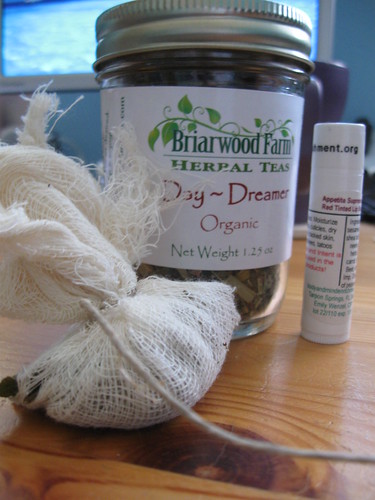

During the hands on portion of the meeting, we each made a little cheesecloth with herbs for a stock to make at home. I included astragalus, bay, oregano, and sage. Here's a trick: keep one end of your string or hemp long so that you can tie it to the side of the pot for easy removal. I usually like to to keep my herbs in the soup so I may add some extra when I use this, but it's definitely a no brainer for herbs that must be removed.

There are refreshments served at every meeting based on the current month's focus herb. Last night the treats were focusing on sage. There was butternut squash soup, one of Emily's veggie herb soups, sage muffins, sage butter, and a salad of watermelon, goat's cheese, and mint. Everything was so delicious and I picked up some of the tea that was served, too.

I even treated myself to some yummy lip balm: I say yummy because it tastes like cinnamon. Its a lovely red color not from artificial dye, but from using alkenet root (it really only gives a hint of color on the lips which is perfect for me for everyday).

I'm glad I went. I had a really nice time.

Wednesday, November 18, 2009

FL Herb Society Meeting: Herbal Vinegars

As of last night, I'm officially a member of the FL Herb Society. Really nice group of ladies, a topic I enjoy, and an excuse to get out and do something. Okay, I'm in. =)

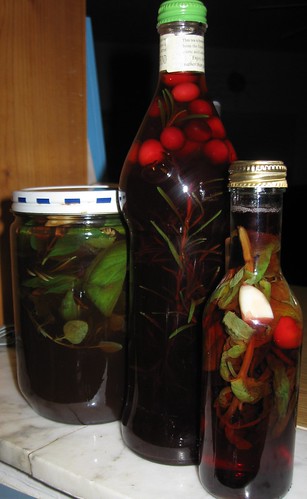
At last night's meeting, we had an herbal vinegar hands on workshop. Beautiful bottles filled with fragrant herbs and some good quality vinegar equal a really pretty, easy to make project that will last throughout the year. Herbal vinegars are a simple way to add flavor to salads, soups, stews, marinades, beverages, and even desserts without added calories, fat, sugar, or salt.


We were told to bring some herbs and bottles, but it turns out that they supplied an enormous amount of gorgeous, fresh herbs and some complimentary bottles (someone had a lot of those little wine bottles laying around!). There were a lot of amazing suggestions for herb & fruit combinations. I made two vinegars while I was there and another when I got home. Since I love Italian food, I made an Italian inspired vinegar while I was there (basil & garlic). I also used one of the suggested combinations of cranberry & rosemary because it just sounds amazing and looks so beautiful in the bottle. Since I had collected a bunch of my own herbs, I made one more vinegar when I got home with basil, rosemary, oregano, and garlic. I used red wine vinegar for all three.

A good rule of thumb is one cup of fresh herbs to flavor one quart of vinegar. Use a good quality vinegar between 6-8% acidity. Clean your herbs and pat dry. There are many recipes that call for heating your vinegar, but it's not necessary. Heating it will infuse it quicker, but the results of the slightly longer wait are supposedly more than worth it (it's my first try, so I don't know yet). Loosely fill your bottle with your herbs of choice and then fill with vinegar. Cap (you should probably use a cork or wax paper with a rubber band since the vinegar's acid will eat away metal) and store in a cool, dark, dry place for 4-6 weeks. When you are satisfied with the flavor, strain through white paper towels or coffee filters until the paper is clean (it may take several tries). Add some fresh herbs to a clean, sterile bottle, fill with the filtered vinegar, seal & label.

Fruit vinegars are made a bit differently. Combine all your ingredients (fruit and vinegar alike) in the top of a non-aluminum double boiler. Simmer, uncovered, approximately 10 minutes. Place in a large glass jar and store 3 weeks. Strain, pressing the fruit to get the juice out. Filter. Add a few berries, fruit, and herbs to your sterilized bottle and fill with your filtered vinegar. Seal and label.

Flavored vinegars will keep up to 18 months or longer if stored in proper containers in a cool, dark place. Some fruit sugars are likely to caramelize after a while and turn slightly brown. It's not attractive but it isn't harmful either. Use fruit vinegars within 3 months to avoid this. Vinegar is a natural preservative, so refrigeration is not necessary.

Cleanliness is essential. Be sure to wash all utensils, bottles, and equipment in hot, soapy water and then rinse in hot water. Always use non-reactive materials such as glass, plastic, or stainless steel.

If you are making some herbal or fruit vinegars for gifts this holiday season, dip your cork into hot wax, add a label, and write a recipe for its use on a small hang tag to tie around the neck of the bottle.

Of course, herbal vinegars can be used medicinally as well as culinary. Herbal vinegars are nutrient dense containing large amounts of calcium, the nutrients from the individual herbs used, and the healing properties of vinegar.

Wednesday, October 21, 2009

Florida Herb Society Meeting

Last night I attended the monthly meeting of the Florida Herb Society for the first time. I was interested to see what the group is about and to also, hopefully, meet other people with some of the same interests I have (I think some people would say: make friends). The meeting was structured a little bit like a union meeting (which kind of cracked me up): the president used a gavel, there was a report from the treasurer, and the secretary read the minutes from the last meeting. There were a lot more people there than I expected: I'd say there were a good 30-40 people there. I say people, but really there were two men and the rest were all more or less senior citizen women with the exception of one of the guest speakers and the VP of the group who were closer to my age. Needless to say, I was a little disappointed that there really wasn't anyone there that I could relate to age-wise, but everyone seemed nice.

They had two guest speakers scheduled: Deserie Valloreo of Herbalwise was scheduled to discuss Herbs for Vibrant Skincare and Kathy Oliver of My Mother's Garden discussed helpful and harmful garden bugs. Deserie provided a great handout and demoed how to make a hydrosol/toner (see the end of this post for instructions). In addition to Kathy's talk, she also had herbs for sale from her organic nursery. I picked up some Texas tarragon and Lemongrass. Texas tarragon is a culinary herb with a lovely, light scent that will be good with poulty, pork, or shellfish. Lemongrass is commonly used in stir fries or Thai food, but it's also great for skincare (as an antiseptic for oily skin) and as a medicinal herb (it removes harmful metals from the body).

I still have A LOT (tons, in fact) to learn, but this meeting (particularly the skincare stuff) taught me that I actually know more than I realize. Despite either knowing much of what was discussed or knowing that I could read it in a book, it was nice to get out and be social even if it wasn't with my peers. Next month they have an herbal vinegar hands on workshop scheduled and even though I pretty much already know how to do this, it could still be fun.

Here's a brief description of the hydrosol/toner demo from Deserie:
Use distilled water combined with your choice of herbs to make an infusion.
Strain your floral water into a spray bottle.
Add 1 or 2 drops of alcohol (preferably vodka since it's pretty much scentless) for every ounce or so of herb water.
Add 3 or 4 drops of your choice of essential oil.
Shake, spray, enjoy!